
Standing Lifts
Lifts that assist someone into standing rather than hoisting them, for anyone who can bear some weight and hold on.
A sit-to-stand lift assists someone into standing rather than lifting them entirely. They hold on, the lift does the hard part, and they finish the movement upright.
Who it suits
Someone who can bear some weight through their legs and can hold on with their hands, but cannot get up unaided.
If the person cannot bear weight at all, or cannot grip and hold, they need a floor lift that takes their full weight in a sling instead. Using a standing lift with someone who cannot participate is unsafe.
Why choose it over a full lift
It is much quicker. A sit-to-stand transfer takes a fraction of the time of a full sling transfer, which matters when it happens six or eight times a day.
It suits toileting. Clothing can be managed while the person is upright, which a full floor lift makes awkward. For many households this is the single reason they buy one.
It maintains strength. The person is still using their legs, still weight-bearing, still participating. Someone moved entirely by a sling for months loses the ability to stand at all, and this keeps that going for longer.
It feels different. Being helped to stand is a very different experience from being hoisted. People who resist a floor lift often accept a standing lift readily.
What to check
Can they hold on, reliably? Grip strength, hand pain and cognition all matter. Someone who lets go partway through is in trouble.
Feet and knees. The person's feet sit on a platform and the knees rest against a pad, so painful knees or feet can rule this out.
Floor space. Smaller than a floor lift but it still needs room to manoeuvre, and compact models exist for tight bathrooms.
Standing slings differ. A standing sling supports under the arms and around the back rather than under the whole body, and cannot be swapped with a floor lift sling.
Some models are not powered at all
Devices such as the Arjo Sara Stedy work mechanically: the person pulls themselves up on the handles and a seat folds in behind them. No battery, nothing to charge, and considerably less expensive, but they require more from the user.
Ask us
Tell us what the person can do unaided, whether they can grip and hold, and what the transfer is for. That decides between a standing lift and a full floor lift faster than any specification.
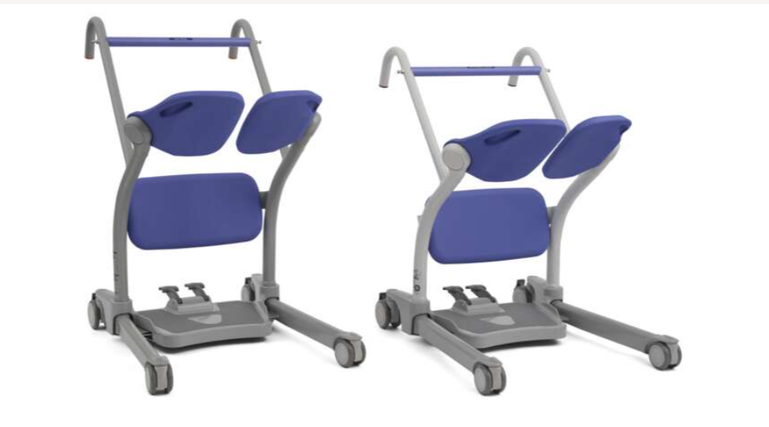
Arjo Sara Stedy Standing Aid
A non-powered standing and transfer aid that lets one caregiver help someone move from sitting to standing and across to another seat. Standard and Compact sizes.
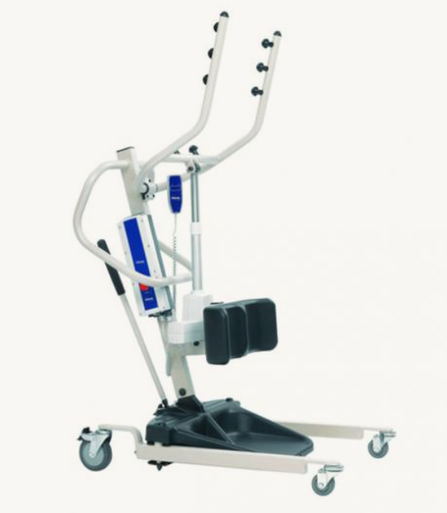
Invacare Reliant 350 Stand-Up Lift
Low stock
A stand-up patient lift with a 350 lb capacity, for caregivers moving someone who can bear some weight through their legs between bed, chair and commode.
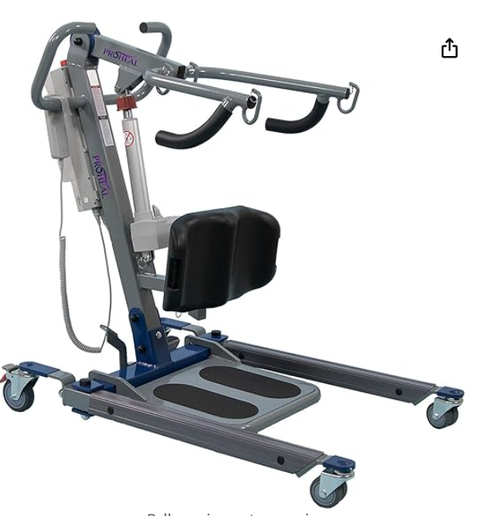
Ref. patient lift - Standing lift
A refurbished sit-to-stand patient lift for moving someone who can bear some weight between bed, chair and commode. Model and supplier vary, so ask us what is on hand.
Ref. Patient Lift - Standing lift [SN]
In stock
A refurbished sit-to-stand patient lift, available through our Mississauga rental stock. Model and supplier vary, so ask us what is on hand.
Used patient lift - Standing lift
A used sit-to-stand patient lift for moving someone who can bear some weight between bed, chair and commode. Model and supplier vary, so ask us what is on hand.
We're here for your questions.
Client, caregiver or therapist — good decisions start with good information. Our team is available seven days a week to help you choose and to check funding eligibility.