
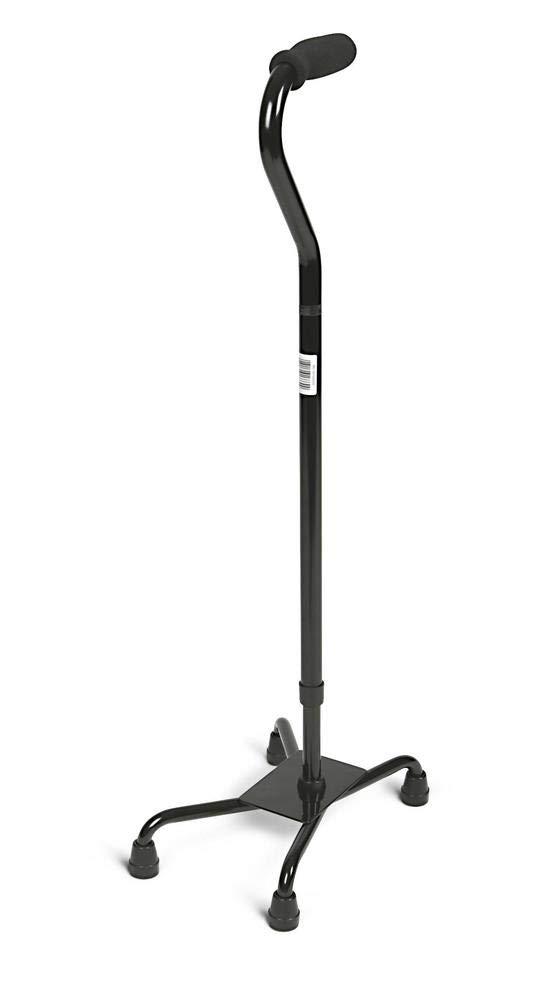
Quad Cane, Large Base
A four-footed cane with a large base, for considerably more support than a standard cane.
Why this one
Four points of contact
Four feet spread the contact, taking more weight and resisting twisting far better than a single point.
It stands unaided
Stands up on its own, so it does not slide down the side of a chair or clatter to the floor.
Maximum stability
The large base gives the most stability, and is the better choice if the cane takes real weight.
Awkward on stairs
A large base is a close fit on a standard stair tread. Choose the small base if stairs are daily.
Land it flat
All four feet must land flat together. Tipping it so only two touch loses most of the benefit.
Know the limit
If you need to lean heavily or hold furniture indoors, a walker is the safer aid.
About this product
A quad cane with a large base: four feet instead of one, giving considerably more support than a standard cane.
The step between a cane and a walker
A standard cane touches the ground at a single point. It steadies you, but it does not hold you up, and there is a limit to how much weight you can safely put through it.
A quad cane spreads that contact over four feet. It takes more weight, resists twisting, and gives a much steadier feel for someone whose balance is genuinely unreliable rather than occasionally uncertain.
It also stands up on its own. That sounds trivial until you have watched someone try to retrieve a cane that has slid down the side of a chair, or seen one clatter to the floor in a waiting room.
Large base or small
This is the large base. It gives the most stability of the two and is the better choice if the cane is taking real weight.
The trade is stairs and tight spaces. A large base needs the whole foot of the cane to land on a step, and on a standard stair tread that is a close fit. If stairs are part of every day, ask about the small base version instead, which sacrifices some stability for easier placement.
Using it well
All four feet should land flat at the same time. If you tip it and only two feet touch, you lose most of the benefit, which is the commonest mistake people make with quad canes.
Height is set the same way as any cane: standing upright in your usual shoes with arms relaxed, the top should sit at the crease of your wrist. It goes in the hand opposite the weaker leg.
If it still is not enough
If you need to lean heavily on the cane, or you are using furniture to get around the house, a walker or rollator is the safer aid. A quad cane is the last step before that, not a substitute for it.
Product Specifications
| Type | Quad cane, large base |
|---|---|
| Contact points | Four feet |
| Stability | The most of our two quad canes, suiting a cane that takes real weight |
| Stairs | A close fit on a standard tread. Choose the small base if stairs are part of every day. |
| Stands alone | Yes, so it does not fall over when set down |
| Height setting | Top of the cane at the crease of the wrist, in the hand opposite the weaker leg |
| Using it | All four feet must land flat at the same time |
| If not enough | A walker or rollator is the safer aid if you need to lean heavily |
Details
| Item code | 24002005 |
|---|---|
| Category | Canes & Crutches |
| Unit | Unit |
Why work with Help Mobility?
Same-Day Delivery
Across the Greater Toronto Area, seven days a week.
Certified Technicians
Trained, certified, and available for service and repairs.
Funding Support
We help you find the funding you qualify for and handle the paperwork with you.
Try Before You Buy
28-day demo program on beds, wheelchairs and bathroom aids.
You may also like
Questions about this product?
Our team is available seven days a week to help you choose and to check funding eligibility.